
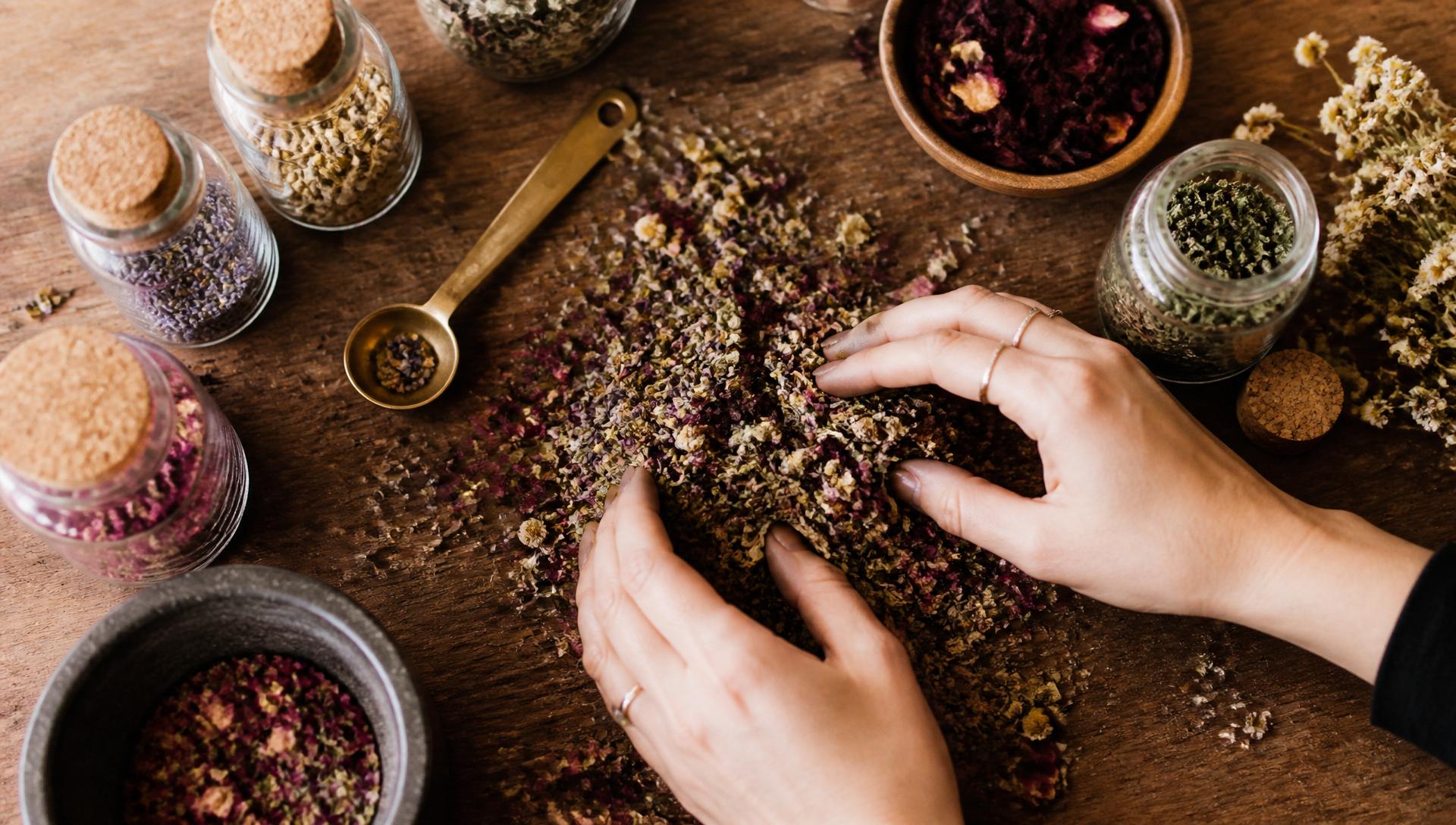
A practical guide
How to make herbal tea blends at home.
Base teas, botanical ratios and flavour pairing — everything you need to build your own cup from dried leaf and flower.
Why blend your own
Blending tea at home is simpler than baking bread and more forgiving than making coffee. You start with a base — something with body and backbone — then layer in botanicals for aroma, colour and character. The result is a cup that tastes exactly like the mood you were in when you built it.
You do not need rare ingredients or specialist equipment. A kitchen scale, a clean jar and a handful of dried herbs are enough to begin. Below is the method we use in our own blending room, scaled down to a kitchen counter.
The method
Four steps, one jar.
01
Choose your base
Start with a base tea that carries the blend. Black tea for body and malt, green for freshness, rooibos for a caffeine-free backbone, or white for delicacy. The base is usually 50–70% of the mix.
02
Pick your botanicals
Add one or two botanicals that complement the base. Floral notes (chamomile, rose, lavender) soften a bold black. Citrus peels and ginger brighten green tea. Spices like cinnamon and cardamom warm rooibos.
03
Set your ratio
A reliable starting point is 60% base tea, 30% primary botanical, 10% accent. For a softer cup, shift to 50% base and 40% botanical. Weigh in grams for consistency — a kitchen scale is your best tool here.
04
Blend and rest
Combine in a bowl and toss gently with clean hands or a spoon. Transfer to an airtight glass jar and let it rest for 24 to 48 hours. The flavours marry in the jar, and the first cup after resting is always better than the first cup fresh.
Choosing a base tea
The base is the backbone of the blend. It provides body, structure and the first note on the tongue. Everything else is decoration.
Black tea
50–70% of blendKenilworth Ceylon or a malty Assam-style. Full-bodied, brisk and tannic. Carries spice, vanilla and citrus peel beautifully.
Pairs with: Cinnamon, cardamom, ginger, orange peel, rose
Green tea
50–60% of blendYunnan or Chinese Sencha-style. Fresh, grassy and slightly smoky. Loves floral and citrus botanicals.
Pairs with: Jasmine, lemon verbena, mint, lemongrass, elderflower
White tea
60–70% of blendMoonlight or Silver Needle. Delicate, creamy and naturally sweet. Needs light-handed botanicals so the leaf isn't overwhelmed.
Pairs with: Rose petals, chamomile, peach, strawberry, vanilla
Rooibos
50–60% of blendNaturally caffeine-free, sweet and woody. A forgiving base that plays well with almost every botanical category.
Pairs with: Vanilla, cinnamon, hibiscus, orange peel, ginger, mint
Oolong
60% of blendMountain copper or Tie Guan Yin. Roasted, buttery and lightly fruity. Unusual but rewarding with stone fruit and florals.
Pairs with: Osmanthus, peach, apricot, rose, chrysanthemum
Botanical families
Botanicals fall into flavour families. Mix within a family for harmony, or across families for contrast. The ratios below are starting points — adjust to your own palate.
Floral
Chamomile, rose petals, lavender, jasmine, hibiscus, elderflower
Softening, aromatic and romantic. Use 10–25% of the blend.
Citrus & Zesty
Lemon peel, orange peel, lemongrass, lemon verbena, bergamot
Bright, clean and lifting. Cuts through heavier bases. Use 5–15%.
Spice & Warm
Cinnamon, cardamom, ginger, clove, black pepper, star anise
Warming, seasonal and grounding. Use 5–15% — they dominate quickly.
Herbal & Leafy
Peppermint, nettle, lemon balm, vervain, tulsi, sage
Cooling, green and refreshing. Use 10–25%.
Root & Earth
Liquorice root, ginger root, dandelion root, turmeric, valerian
Deep, sweet and grounding. Liquorice in particular adds natural sweetness. Use 5–15%.
Fruit & Berry
Apple, rosehip, strawberry, blackberry leaf, sea buckthorn, sloe
Tart, jammy and naturally sweet. Use 10–20%.
Starter recipes
Six blends to begin with
Use these as written, or treat them as templates. Swap the base, double a botanical, or add a pinch of something unexpected. The best blend is the one that tastes right to you.
The Evening Wind-Down
Base: Rooibos (60%)
Botanicals: Chamomile (25%), lavender (10%), valerian root (5%)
Soft, honeyed and herbal. A twilight ritual in a cup.
Citrus Garden
Base: Green tea (55%)
Botanicals: Lemon verbena (20%), lemon peel (15%), jasmine (10%)
Bright, sherbet-like and refreshing. For slow weekend mornings.
Fireside Chai
Base: Black tea (50%)
Botanicals: Cinnamon (15%), cardamom (15%), ginger (15%), clove (5%)
Warming, spiced and aromatic. The kitchen-window cup on a cold day.
Hedgerow Brew
Base: Black tea (60%)
Botanicals: Rosehip (20%), hibiscus (10%), elderflower (10%)
Tart, fruity and ruby-red. An autumnal walk in a cup.
Soft & Floral
Base: White tea (65%)
Botanicals: Rose petals (25%), chamomile (10%)
Delicate, creamy and quietly romantic. Best steeped gently.
Root Restore
Base: Rooibos (55%)
Botanicals: Ginger (20%), liquorice root (15%), cinnamon (10%)
Earthy, sweet and warming. A grounding cup for slower afternoons.
Storage & tips
Keep it airtight
Light, air and moisture are the enemies of dried botanicals. Store blends in amber or cobalt glass jars with tight lids, or in lined paper pouches inside a tin. Keep away from the cooker and direct sun.
Label everything
Write the blend name, date and rough ratio on the jar. What seems obvious today will be a mystery in three months. Include the base tea type so you remember the brew temperature.
Rest before judging
A blend tastes different after 48 hours in the jar. The volatile oils from botanicals migrate into the base tea and the whole thing smooths out. Patience is part of the process.
Start small
Blend 20g at a time while you are experimenting. A disappointing 20g batch is a lesson. A disappointing 200g batch is a cupboard ghost. Scale up only when a recipe is exactly right.
Note what you do
Keep a simple notebook: base, botanicals, percentages, tasting notes. The best blenders are the best record-keepers. After a dozen entries you will see patterns in what you gravitate toward.
Ready-made blends, still hand mixed
If you would rather explore than experiment, our own blends are built on the same principles — a proper base, quality botanicals, and nothing artificial. You can always deconstruct the pouch to see how we did it.